
Orientation, not ontology
Speculative postscript to GIFT.
Foreword
What follows is not part of GIFT. The theoretical framework, its predictions, and its falsifiable claims stand or fall on their technical merits alone, independently of anything in this essay. What I offer here is the personal orientation that motivated the work: a speculative philosophical posture that informs my taste for problems, not the substance of my results.
Read this as an author’s commentary, not as a theoretical claim. If you came for physics, the papers are elsewhere. If you came for metaphysics, you’ll find an honest sketch here, but no system.
Why this essay exists
Over the last few months, several attentive readers of GIFT have raised a question the papers themselves do not address: why this structure rather than another? Why a compact 7-manifold with G₂ holonomy, why the specific Betti numbers (b₂, b₃) = (21, 77), why E₈ × E₈?
The papers do not answer this question because they cannot. No physical theory I know of fully answers its own selection question. The Standard Model does not explain its gauge group. String theory has its landscape problem. General relativity does not derive the dimensionality of spacetime. The selection question is structural to fundamental physics, not specific to any one framework.
But I have an orientation (not an answer, an orientation) that has guided the choices I made throughout the development. It would be dishonest to publish technical work without ever acknowledging that such an orientation exists. This essay sketches it out, on the explicit understanding that nothing in what follows can be wielded against the technical papers, because nothing in what follows is offered as a theory.
The lineage of mathematical tools
A first observation, philosophically modest but consequential.
The mathematical tools we use to describe physics do not arrive all at once. They form a historical lineage of progressive refinement: differential calculus, differential geometry, functional analysis, topology, representation theory, exceptional holonomy, computational verification. Each refines a different aspect of what can be interrogated. None replaces the others; each adds discrimination at a particular layer.
This matters because it dissolves a tempting question. When I work with G₂ holonomy and the exceptional Lie algebras, I am not claiming that these specific structures correspond to deep features of reality. I am using the most discriminating tools currently available for the questions I am trying to ask. Fifty or two hundred years from now, finer tools will exist that make G₂ look as primitive as arithmetic looks to us today.
This stance is humble without being deflationary. I do not believe the lineage converges to nothing, nor that it drifts in random directions. I believe it is shaped by something: by physical reality itself, by the constraints reality imposes on what can function as a tool, and by other constraints we have yet to discover. But I do not need a metaphysics of that shaping to do the work. It is enough to recognise that the tools I use are temporarily sharp and fundamentally provisional.
The ontological wager
If there is an ontological wager behind GIFT, it is not that reality “is” a G₂ manifold, an E₈ × E₈ structure, or any other present-day mathematical object. Mathematical objects are tools, and tools evolve.
The wager is more modest, and harder to dislodge: physical law may be the visible residue of deep self-consistency constraints, and topology may be the part of those constraints that survives deformation.
Self-consistency, here, is not a single mathematical operation. It shows up at several scales, and what interests me is their convergence rather than any one of them taken in isolation.
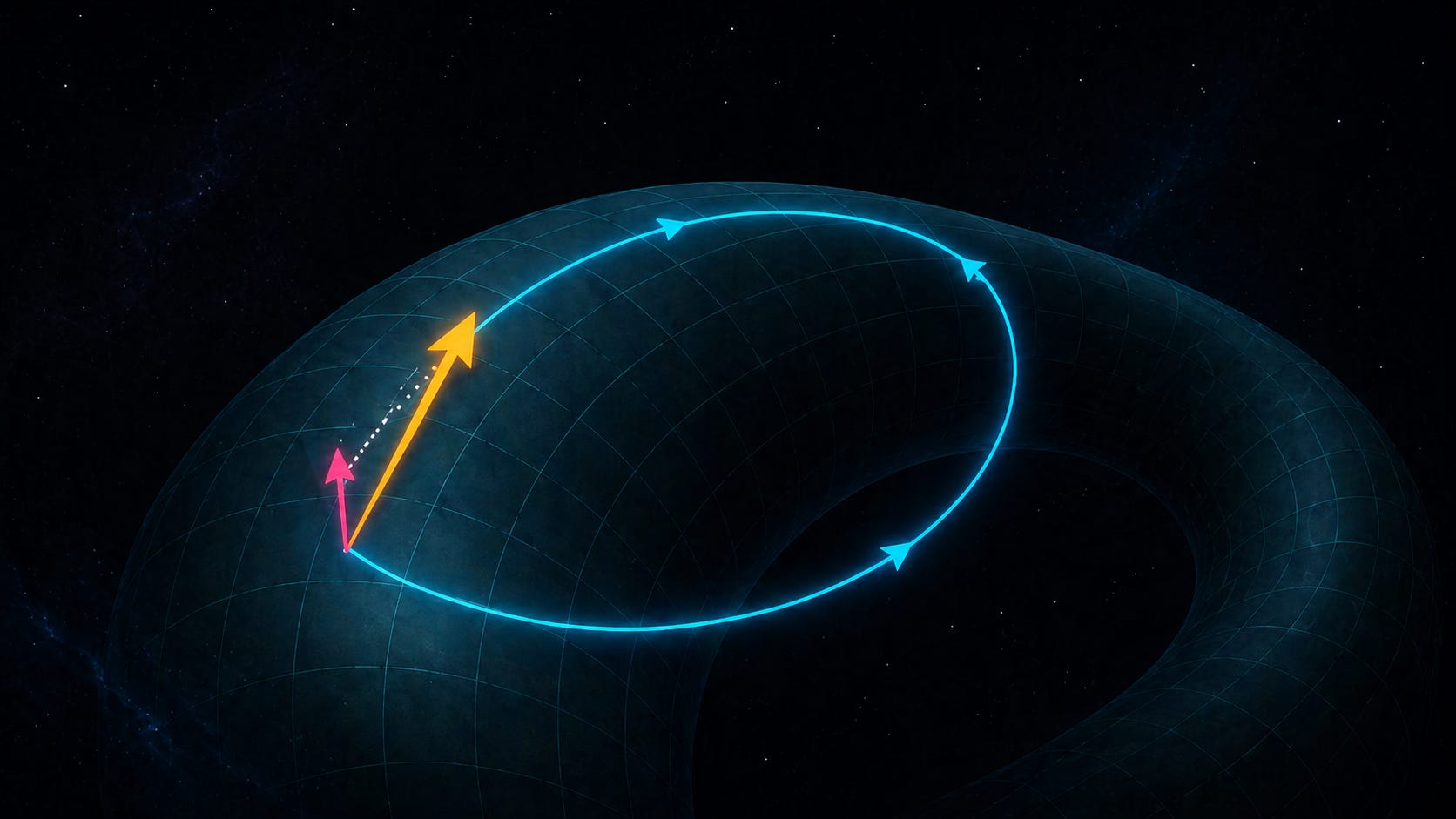
At the local level, it manifests as holonomy. When you transport a vector along a closed loop on a Riemannian manifold, it returns to its starting point with a rotation that depends on the local geometry traversed. For G₂ holonomy manifolds, this rotation is constrained to lie in an exceptional 14-dimensional group, not the generic 21-dimensional SO(7), but a rigid subgroup whose structure cannot be deformed without destroying the calibration property of the 3-form. This is a geometric self-consistency: the way space curves locally must be compatible with itself once the loop closes.
At the algebraic level, it manifests as the rigidity of exceptional structures. The classical Lie algebras come in infinite families indexed by rank. The exceptional algebras (G₂, F₄, E₆, E₇, E₈), by contrast, are finite in number, the Killing–Cartan classification identifies exactly five, and none can be obtained as a limiting case or natural extension of the others. E₈ has 248 dimensions, not 247 or 249 ; that number is non-negotiable within the classification. This is an algebraic self-consistency: internal constraints lock the global parameters of the structure with no free adjustment available within the classification.
At the global level, it manifests as topological stability under continuous variation. The Betti numbers of a compact manifold do not change under differentiable deformation. The signature of a 4-manifold is a cobordism invariant. The Euler characteristic resists any local manipulation. These invariants survive precisely because they encode properties the manifold has as a whole, not as an aggregate of local pieces. This is a global self-consistency: what characterises the object cannot be altered by modifying its parts.
None of these operations is exotic on its own. What is interesting is that the structures fundamental physics keeps turning to tend to satisfy several of them at once. A G₂ manifold with its specific Betti numbers stacks all three: rigid local holonomy, links to exceptional algebras through symmetry groups, fixed global topological invariants. It is this convergence (not any one of the three properties in isolation) that grounds the conviction that something here is being captured beyond an artefact of description.
This observation does not select a manifold. It does not derive a constant. It does not justify a prediction. What it does is explain a research bias: when looking for compressions of physical observables, I tend to trust structures constrained along several axes, those that cannot be casually deformed without losing their constitutive properties, more than structures that are merely locally rigid or merely globally stable.
The wager, in the end, is that the more layers of self-consistency a structure satisfies, the less likely it is to be an artefact of how we chose to describe the problem, and the more likely it is that something physical is being captured. This is a wager, not a theorem. I want to be very clear about that.
Philosophical lineage
This orientation is not original to me. It belongs, as far as I can tell, to a relatively well-identified philosophical tradition: structural realism, a contemporary programme in the philosophy of physics with its own bibliography, internal debates, and critics.
The modern formulation of structural realism is generally attributed to John Worrall, in a 1989 paper (Structural Realism: The Best of Both Worlds, Dialectica). Worrall was responding to a classical difficulty in the philosophy of science: Larry Laudan’s “pessimistic meta-induction”, which holds that the history of science shows successive theories positing fundamentally different entities (Fresnel’s ether, Maxwell’s electromagnetic field, the photons of quantum mechanics), and that this should make us sceptical of the entities posited by current theories. Worrall’s reply: what is preserved across theory change is not the nature of the entities but the structural relations: the equations, the invariants, the mathematical ratios. What survives is the structure; what changes is the interpretation of the relata.
This position has since split into two families, distinguished by James Ladyman in a foundational 1998 paper (What is Structural Realism?, Studies in History and Philosophy of Science). Epistemic structural realism (ESR) holds a modest thesis: we can only know the structure of the world, not the intrinsic nature of the objects that bear it. Ontic structural realism (OSR), developed in particular by Ladyman and Don Ross in Every Thing Must Go (2007) and by Steven French in The Structure of the World (2014), pushes further: structure is not merely what we can know, it is what there is. Objects are not primary, secondarily supporting relations ; relations are primary, and objects are nodes in the relational structure.
The orientation described in this essay sits closer to a moderate OSR than to ESR. When I say that physical law may be the visible residue of self-consistency constraints, and that topology records what survives deformation, I am saying something that presupposes that structural constraints have an ontological status of their own: that they are not merely our best description, but capture something about how reality is articulated. That places me in the OSR family, without committing to its more radical formulations.
This lineage has serious critics, and it would be dishonest to ignore them. Newman’s objection (formalised by M.H.A. Newman in 1928 against Russell, and revived against ESR by Demopoulos and Friedman in 1985) points out that knowing only the “structure” of the world in a purely formal sense is almost trivial: for any sufficiently large set of objects, one can define relations satisfying any given abstract structure. Structural realism therefore has to specify what it means by “structure” in a way that goes beyond pure logical satisfaction. Stathis Psillos has developed a systematic critique of ESR (notably in Scientific Realism: How Science Tracks Truth, 1999), arguing that the structure/nature distinction is untenable and that structure cannot be maintained independently of some understanding of what it structures. These objections are live; the debate has not closed them.
GIFT does not aim to arbitrate between these positions. The orientation described here operates within a frame where ontic structural realism is taken seriously as a research programme in the philosophy of physics, and where the project of capturing topological invariants and exceptional algebraic structures is understood not as aesthetic affectation but as a strategy coherent with that programme. Whether the programme is ultimately defensible is an open question for philosophy, not for GIFT’s technical papers.
What this orientation produces, and what it does not
This orientation has a definite scope. Let me be explicit about what it does and does not do.
It produces a taste for structures with multi-layered self-consistency, for topological invariants (what survives any continuous deformation is more likely to be structural than incidental), and for exceptional configurations (rare structures are more likely to be selected than generic ones). It produces a disposition to take seriously the question of why certain specific mathematical structures keep showing up in physics, without needing to answer it.
It produces none of GIFT’s predictions. Those come from specific topological invariants and algebraic combinations, computable independently of any orientation. It produces none of the techniques: the Newton–Kantorovich diagnostics, the spectral geometry computations, the Lean 4 verification. It produces none of the falsifiable claims that distinguish GIFT from speculation.
The technical work stands on its own feet. This essay accompanies it. The two should be judged separately.
Coda
My papers are technical. This essay is not. I keep them separate because they must be judged separately.
But honesty requires me to acknowledge that the technical work is shaped by an orientation it does not name. Pretending otherwise, publishing papers as if they emerged from pure formal manipulation, with no underlying intuition, would be a more serious distortion than admitting, here, in a clearly labelled space, what that intuition is.
The papers say what can be defended. This essay says what is true about how I came to write them. The work continues...
Indicative references
For the reader who wishes to explore the philosophical lineage mentioned above:
Worrall, J. (1989). Structural Realism: The Best of Both Worlds. Dialectica, 43(1-2), 99–124.
Ladyman, J. (1998). What is Structural Realism?. Studies in History and Philosophy of Science, 29(3), 409–424.
Ladyman, J., & Ross, D. (2007). Every Thing Must Go: Metaphysics Naturalized. Oxford University Press.
French, S. (2014). The Structure of the World: Metaphysics and Representation. Oxford University Press.
Psillos, S. (1999). Scientific Realism: How Science Tracks Truth. Routledge.
Stanford Encyclopedia of Philosophy, entry Structural Realism (Ladyman, regularly updated), for an accessible survey.
Further reading
The framework: gift-framework.github.io/GIFT/
How it happened: giftheory.substack.com/p/brieucs-gift